.jpg.opt621x975o0,0s621x975.jpg)
Fish species
1) Koi - Koi varieties are distinguished by coloration, patterning, and scalation. Some of the major colors are white, black, red, yellow, blue, and cream. The most popular category of koi is the Gosanke, which is made up of the Kohaku, Taisho Sanshoku, and Showa Sanshoku varieties.
2) Comet - The comet goldfish can be distinguished from the common goldfish by its long, single and deeply forked tail fin. Under optimum conditions, the tails can grow up to 12 inches in length. Comets with yellow, orange, red, white, and red-and-white coloration are common. The red coloration mainly appears on the tailfin and dorsal fin, but can also appear on the pelvic fin. The Comet is more active than most other goldfish breeds.
3) Angel - is a small genus of freshwater fish from the family Cichlidae known to most aquarists as "Angelfish". All Pterophyllum species originate from the Amazon River, Orinoco River and Essequibo River basins in tropical South America. The three species of Pterophyllum are unusually shaped for cichlids being greatly laterally compressed, with round bodies and elongated triangular dorsal and anal fins. This body shape allows them to hide among roots and plants, often on a vertical surface. Naturally occurring angelfish are frequently striped longitudinally, colouration which provides additional camouflage. Angelfish are ambush predators and prey on small fish and macroinvertebrates. All Pterophyllum species form monogamous pairs. Eggs are generally laid on a submerged log or a flattened leaf. As is the case for other cichlids, brood care is highly developed.
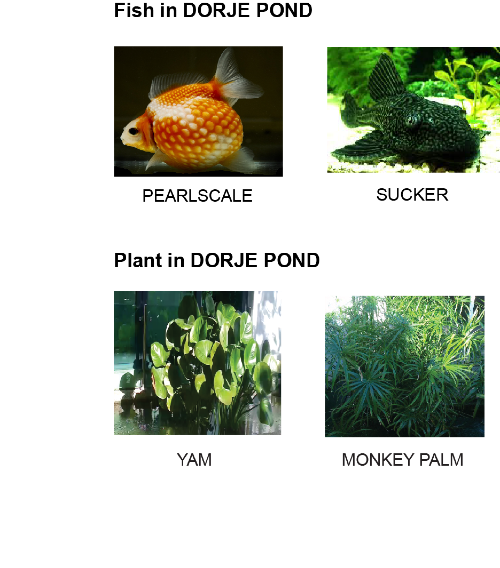
4) Sucker - Hypostomus is the largest genus of the armored catfish native to Central and South America. It includes the popular freshwater aquarium fish Plecostomus (formerly Plecostomus plecostomus). As in all loricariids, Hypostomus species have a sucker mouth. They use their mouth as well as the pectoral, pelvic and caudal fin areas, to interact with the rocky river-bottom. The comb-toothed inferior mouth of the Hypostomus is able to grasp green algae on the river bottom. With the help of the suckermouth, which anchor the fishes, in conjunction with the arched design of pectoral and pelvic fin spines, they are also able to remain upright while exploring this substratum.
5) Carp - Carp are various species of oily freshwater fish of the family Cyprinidae, a very large group of fish native to Europe and Asia. Most cypriniformes have scales and teeth on the inferior pharyngeal bones which may be modified in relation to the diet. Tribolodon is the only cyprinid genus which tolerates salt water, although there are several species which move into brackish water, but return to fresh water to spawn. All of the other cypriniformes live in continental waters and have a wide geographical range.
6) Ryukin - The ryukin is a short deep-bodied fancy goldfish with a characteristic hump in the shoulder region. The ryukin is a hardy and attractive variety of goldfish with a pointed head and has a pronounced hump on the back behind the head. It may be long-finned or short-finned with either a triple or quadruple tail. The dorsal fin is high while the caudal fin is often twice as long as the body. The caudal fin may also have three or four lobes. The ryukin is a fine aquarium fish that can reach up to 8 inches (21 centimeters) in length.
7) Cichlids - Cichlids are fishes from the family Cichlidae in the order Perciformes. Cichlids are members of a group known as the Labroidei along with the wrasses (Labridae), damselfish (Pomacentridae), and surfperches (Embiotocidae). Cichlids span a wide range of body sizes, from species as small as 2.5 centimeters (0.98 in) in length. Cichlids are less commonly found in brackish and saltwater habitats, though many species tolerate brackish water for extended periods
8) Glass catfish - The Glass Catfish (Kryptopterus bicirrhis) is an Asian glass catfish of the genus Kryptopterus. Until 1989, it included its smaller relative the Ghost Catfish, now known as K. minor. The main difference to K. minor is the longer anal fin of the Glass Catfish, which in the latter has more than 54 and up to 68 rays. The present species also grows much larger – 15 cm (5.9 in) standard length, or twice the size of its relative; specimens measuring as much as 24.5 cm (9.6 in) standard length are reputed to exist. Its head is also lighter on average.
9) Parrot fish - Parrotfishes are a group of fishes that traditionally has been considered a family (Scaridae), but now often are considered a subfamily (Scarinae) of the wrasses. They are found in relatively shallow tropical and subtropical oceans throughout the world. Maximum sizes vary within the family, with the majority of species reaching 30–50 centimetres (12–20 in) in length. However, a few species reach lengths in excess of 1 m, and the green humphead parrotfish can reach up to 1.3 metres to 4.3 ft.
10) Isok Barb - Isok barb is found in Malaysia, Thailand, Cambodia, and Vietnam. There are no visible differences between the sexes. It is believed that as Probarbus jullieni are slow growers, they can live for up to 25 years. The Isok barb is classed as the most endangered fish species on the planet; this is due to over fishing in its natural habitat. Specimens of these fish are rarely seen in the aquarium trade. These fish may grow up to 150 cm in length, so they are suitable for really large tanks only.
11) Butterfly koi - Butterfly Koi, Longfin Koi, or Dragon Carp are a type of ornamental fish notable for their elongated finnage. The fish are a breed of the common carp, Cyprinus carpio, which includes numerous wild carp races as well as domesticated koi ("Nishikigoi"). Butterfly Koi originated in the mid-20th century as a result of an effort to increase the hardiness of traditional koi. Japanese breeders interbred wild Indonesian Longfin river carp with traditional koi. The ideal shape of a koi has been set by tradition to be generously oval. By contrast, butterfly koi are naturally more slender. This difference is amplified by the fact that traditional koi judging is done from a top-down viewing angle.
2) Comet - The comet goldfish can be distinguished from the common goldfish by its long, single and deeply forked tail fin. Under optimum conditions, the tails can grow up to 12 inches in length. Comets with yellow, orange, red, white, and red-and-white coloration are common. The red coloration mainly appears on the tailfin and dorsal fin, but can also appear on the pelvic fin. The Comet is more active than most other goldfish breeds.
3) Angel - is a small genus of freshwater fish from the family Cichlidae known to most aquarists as "Angelfish". All Pterophyllum species originate from the Amazon River, Orinoco River and Essequibo River basins in tropical South America. The three species of Pterophyllum are unusually shaped for cichlids being greatly laterally compressed, with round bodies and elongated triangular dorsal and anal fins. This body shape allows them to hide among roots and plants, often on a vertical surface. Naturally occurring angelfish are frequently striped longitudinally, colouration which provides additional camouflage. Angelfish are ambush predators and prey on small fish and macroinvertebrates. All Pterophyllum species form monogamous pairs. Eggs are generally laid on a submerged log or a flattened leaf. As is the case for other cichlids, brood care is highly developed.
4) Sucker - Hypostomus is the largest genus of the armored catfish native to Central and South America. It includes the popular freshwater aquarium fish Plecostomus (formerly Plecostomus plecostomus). As in all loricariids, Hypostomus species have a sucker mouth. They use their mouth as well as the pectoral, pelvic and caudal fin areas, to interact with the rocky river-bottom. The comb-toothed inferior mouth of the Hypostomus is able to grasp green algae on the river bottom. With the help of the suckermouth, which anchor the fishes, in conjunction with the arched design of pectoral and pelvic fin spines, they are also able to remain upright while exploring this substratum.
5) Carp - Carp are various species of oily freshwater fish of the family Cyprinidae, a very large group of fish native to Europe and Asia. Most cypriniformes have scales and teeth on the inferior pharyngeal bones which may be modified in relation to the diet. Tribolodon is the only cyprinid genus which tolerates salt water, although there are several species which move into brackish water, but return to fresh water to spawn. All of the other cypriniformes live in continental waters and have a wide geographical range.
6) Ryukin - The ryukin is a short deep-bodied fancy goldfish with a characteristic hump in the shoulder region. The ryukin is a hardy and attractive variety of goldfish with a pointed head and has a pronounced hump on the back behind the head. It may be long-finned or short-finned with either a triple or quadruple tail. The dorsal fin is high while the caudal fin is often twice as long as the body. The caudal fin may also have three or four lobes. The ryukin is a fine aquarium fish that can reach up to 8 inches (21 centimeters) in length.
7) Cichlids - Cichlids are fishes from the family Cichlidae in the order Perciformes. Cichlids are members of a group known as the Labroidei along with the wrasses (Labridae), damselfish (Pomacentridae), and surfperches (Embiotocidae). Cichlids span a wide range of body sizes, from species as small as 2.5 centimeters (0.98 in) in length. Cichlids are less commonly found in brackish and saltwater habitats, though many species tolerate brackish water for extended periods
8) Glass catfish - The Glass Catfish (Kryptopterus bicirrhis) is an Asian glass catfish of the genus Kryptopterus. Until 1989, it included its smaller relative the Ghost Catfish, now known as K. minor. The main difference to K. minor is the longer anal fin of the Glass Catfish, which in the latter has more than 54 and up to 68 rays. The present species also grows much larger – 15 cm (5.9 in) standard length, or twice the size of its relative; specimens measuring as much as 24.5 cm (9.6 in) standard length are reputed to exist. Its head is also lighter on average.
9) Parrot fish - Parrotfishes are a group of fishes that traditionally has been considered a family (Scaridae), but now often are considered a subfamily (Scarinae) of the wrasses. They are found in relatively shallow tropical and subtropical oceans throughout the world. Maximum sizes vary within the family, with the majority of species reaching 30–50 centimetres (12–20 in) in length. However, a few species reach lengths in excess of 1 m, and the green humphead parrotfish can reach up to 1.3 metres to 4.3 ft.
10) Isok Barb - Isok barb is found in Malaysia, Thailand, Cambodia, and Vietnam. There are no visible differences between the sexes. It is believed that as Probarbus jullieni are slow growers, they can live for up to 25 years. The Isok barb is classed as the most endangered fish species on the planet; this is due to over fishing in its natural habitat. Specimens of these fish are rarely seen in the aquarium trade. These fish may grow up to 150 cm in length, so they are suitable for really large tanks only.
11) Butterfly koi - Butterfly Koi, Longfin Koi, or Dragon Carp are a type of ornamental fish notable for their elongated finnage. The fish are a breed of the common carp, Cyprinus carpio, which includes numerous wild carp races as well as domesticated koi ("Nishikigoi"). Butterfly Koi originated in the mid-20th century as a result of an effort to increase the hardiness of traditional koi. Japanese breeders interbred wild Indonesian Longfin river carp with traditional koi. The ideal shape of a koi has been set by tradition to be generously oval. By contrast, butterfly koi are naturally more slender. This difference is amplified by the fact that traditional koi judging is done from a top-down viewing angle.
12) Pearlscale - The pearlscale or chinshurin in Japanese, is a spherical-bodied fancy goldfish with finnage similar to the fantail . The characteristic feature of the pearlscale is its thick, domed scales with pearl-like appearance. Its body is round and similar to a golf ball. The finnage may be long or short. Pearlscales can reach up to 8 inches long and grow up as large as oranges.However, pearlscale fancy goldfish are prone to swimbladder disorders which affect the ability to maintain normal position in the water. This is attributed to the selective breeding process of fancy goldfish to achieve particular body forms, such as that of the pearlscale's. Selective breeding gradually resulted to the alteration of the appearance of the swimbladder. It is also known as the Ping Pong Pearlscale.
The fishes mentioned above are
suitable to live in the same pond. In any case of fish removal, it is
recommended to replace with the fishes mentioned above.
In any case that a fish is sick, it is recommended to place the fish in the quarantine tank and seek for specialist advise.
Rinpoche has a fish called Dorje (video; below). It is a carp fish, and more information on him can be found here.
As of 28 July 2012, it is advised that no more fish should be added into the U-pond, unless some are taken out.
